Marketing mumbo-jumbo

I’ve read quite a big amount all kind of guides during last year or so. E-books and blogs, about photography business and it’s marketing, social media strategies, how-to-write-blogs blogs etc.etc.

I started this lesson mainly because of curiosity. I was sceptic about all these marketing speeches of marketing speeches, you know – “by reading my amazing book your success is guaranteed 110% and you reach wealth, health, and everything you didn’t even know you wanted!”. Sounds ridiculous, but I didn’t want to judge beforehand, but see if there was some wisdom behind stupid phrases or not.

Also, it was an process of searching the valuable information. Today finding it usually means that one has to go through a lot of not so valuable information – a curse of net age, there are no gate-keepers on this information superhighway.

But sure there was also little suspicion that something big was happening, and I was dropped out of it, didn’t know about it, didn’t understand it.

Anyway, I wanted to know and so I started to read. What did I found?

Not much actually. I wasn’t missing any big wave. There wasn’t much new information or real strategies. Most of these amazing secrets were just simple common sence things.

Some information about processes of search engines and opimization was new and interesting. But after all, ranking well in Google search means ranking well in Google search. It doesn’t automatically mean success in any measurements. And that optimization side right away raised the question who is the audience – if you’re writing a blog optimized for Google you’re probably writing quite boring blog. Search engine algorithms are not very well known for their respect of literal culture and well written stories. How often you’ve found that that fourth or fifth article behind that first one you found on Google was better written, more informative? My own aswer: all the time. If the things we put into the web, were they photographs or texts or something else, don’t have originality and creative qualities they won’t gain much interest, popularity, interaction or feedback, no matter how well they are optimized and keyworded.

Did I found blogs and books I would recommend?

No, not really, to be honest. Some were better than others, of course, but I didn’t found any that I would really want to recommend for other people. This isn’t rocket science. By thinking and using the knowledge you already have (analyzing a bit your own behaviour in web is very good starting point) you’ll probably be as ready for hitting the information superhighway as by reading miracle promising books and blogs.
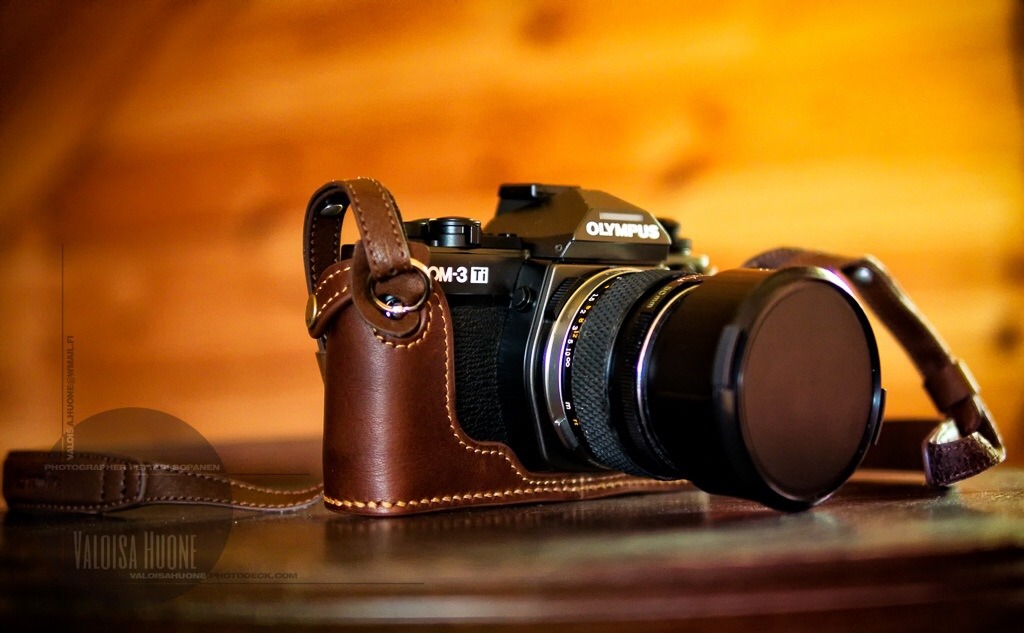
My latest baby

(A kind of a follow-up to this previous story.)

In late ‘90’s pro camera world there was a duel between Canon EOS-1n and Nikon F5. But there were others if you were a step beyond mainstream.

Back then in a local shop was used Olympus OM-2n and few lenses, 28/2.8, 50/1.4 and 100/2.8. I bought the kit – and fell in love with it. And since then titanium bodies of OM-series have been something I’ve wanted. Both OM-3Ti and OM-4Ti were still in production then and available, but expensive. I had just gone into world of Hasselblad and so Ti was left behind then.

But not forgotten. Every now and then they popped up in my mind as cameras that would be so nice to have. Even during and after the digital revolution. When I browsed eBay for something I needed, I often checked what was for sale – just for curiosity…

…and you guess it, one day it just happened. Mint OM-3Ti had a hefty price tag – but there was an option for offers and – just for curiosity, of course – I placed an offer. Much less than the “buy it now” price but surprisingly seller accepted my offer. So I became an owner of an Olympus OM-3Ti.

First impression when I got my hands on it was it’s heaviness. The Real Thing, not much plastic here. No miniature buttons and browsing menus either. Instead that impressive feeling of exactness of mechanical quality. This was The Camera, not just some image-making-thing.

It is a collectable item, but I am a photographer. So I have shot few rolls with it. First impressions of quality have only strengthened. And seeing processed films also proved the beauty of multi spot metering system. It gives lots of control for photographer, but same time give exactness to exposure. Sophisticated system.

I’m quite sure that despite of it’s rarity and value as collector item this thing is not going to be left to rest in peace in it’s original box. I will take it out now and then and shoot few rolls, just for the feeling it gives. And after all that is what these things were produced for.

Me, a gear junkie…?

I admit that I have larger range of cameras than I actually need. But I refuse to call myself gear junkie.

Photographers make pictures, not camera bodies – not even lenses. Better camera doesn’t make better photographer – or opposite. I am firm believer of this philosophy. But I don’t accept the thesis that camera doesn’t affect at all.

I believe that it is very important for every photographer to have a camera that suits his/her needs – needs which are highly personal. Suitable camera is one that doesn’t steal photographer’s attention. It lets photographer to focus on his/her subject, it is a extension of his/her eye and hand.

So, the answer to the question why I have so many cameras is that they are marks of the search of the most suitable camera. That search is a continuous process. I must say that I haven’t sold many cameras I’ve owned, which means that I have mostly found suitable cameras – and even more suitable cameras…

That*s about cameras and photography. But I must also admit that if I had lots of money, time and room, I would own even more cameras and lenses. Lot’s of them. But that is another story – that is a story of camera collector.

Being a collector is about admiring cameras as obejcts, precicion devices, marveling their mechanical and optical quality, respecting skill and craftmanship that has produced them.

But like I said I don’t have what i t takes to be a real collector, so I’ve fallen somewhere between collector’s and photographer’s mentality. My range of cameras belong to two groups. Those which are purely tools that suit my needs as a photographer (all my digital cameras have belonged to this group) and those which have certain value as collectables, but are still usable as photographic tools – and again, suitable. (All my present analog cameras belong this group.)

Scanning

I bought the scanner for couple of months ago, but was a bit too busy to start this archive project right away. Like I’ve told previously, now is the time to do it. So hardware assembled, software installed – go for it!

I’ve done quite a lot of scanning back in 90’s when it was still analog age. I was working as a assistant in design school and it meant that I had access to quite impressive arsenal of tools – at least back then sellers of software and hardware were quite generous when customer was a school educating young people, which they considered potetial future clients. So, I was familiar with different things from cheap-looking plastic Polaroids to very professional heavy-duty Imacons.

And so I thought that since I considered myself experinced, couple of days playing around with my new equipment would get me going seriously. I was wrong.

I very soon noticed that Silverfast 8 was totally different thing from those 90’s scanner softwares. Sophisticated, versatile, with lot’s of different workflow possibilities – including editing that previously was clearly on Photoshop-side of process.

Feeling like going back to school, I’m now gathering knowledge, reading and learning new things, designing my own workflow to suit new tools and needs.

It didn’t go like I thought, but this actually makes things more interesting, it’s always more motivating to learn new tricks than to do that same old all time.

Statement, part II

(First part can be read either on previous blog, or on Valoisa Huone website.)

It might sound self-evident, but I think it is always not so clear. There is so much equipment today; computer hardware, software with almost endless repertoire of editing and manipulation possibilities, cameras with lots of automatic functions. It’s actually quite easy to let all these take over the control of image and push photographer to a role of supporting actor. As a photographer being an auteur is being the director, one who makes decisions and controls the image.

Independence defines my relation to others. Clients, editors, producers, models. Audience. It’s got nothing to do with arrogance or any kind of negative behaviour – I am a co-operative gentleman. But as I by auteurism wanted to make clear I’m in contol of my images when it comes to technical issues, independence means that as a photographer I keep that kind of control of my photography that I can proudly stand and say that these are My Photographs. Healthy braveness of ones creative work, that is.

Three principles described shortly. Principles are just that, principles – true everyday of course is more about compromises, but to get practice closer to principles, target ideas have to be cleared.

Statement, part I

Three keywords of my photographical philosophy.

Amateurism, auteurism, independence.

Virginal eye of an amateur is something I want to keep. Even tough it’s not always easy in today’s world where the visual is overflowing everywhere and everything has already been seen, photographed and shared. Amateurism is at first quality of seeing. And seeing always comes first, photography builds on the base of seeing. Virginal eye has nothing to do with my cameras, amateurism is not the quality of my photographic efforts. It’s the way of seeing the world around.

Auteurism of couse comes from the world of François Truffaut, André Bazin and Cahiers du cinéma. But I think it’s valid still, sixty years after the French New Wave was introduced and in the world of photography. This is more about the process. Like those film critics of Cahiers stated, director is the auteur, the creator, the artist. Same way the photographer is the auteur of photograph.

Due to some linking reasons this text is published in two parts, so please continue to part II…

Valoisa Huone has moved

Nothing dramatic and definately only positive. I’m finally on my three months free from paid work. Educational holiday that is to say. And that means also that I packed my Mac and stuff into car and moved my office to my family’s summer house to have a wilderness studio like all famous artists…

Ok, not really a studio, no wilderness either (nearest city is only 15 kilometres away…). Actually just a desk on upstairs of cottage, but anyway, changing scenry a bit seemed a good option to shift gears.

Besides computer stuff I took an old briefcase with me. It’s filled with 135 mm and 120 slides shot on 90’s an early 2000’s. So, my project will be going through that archive with new eyes, scan – and rescan. There are some images digitized already back then when they vere shot , but also lots of stuff that is never used anywhere.

I guess I will be both ashamed and happily surprised when going through that old stuff…

Some progress. Again.

My photographic life has been quite quiet lately. There has been other activities.

Yesterday I finally got going again with editing – not a giant leap, but small step anyway – eight new uploads on Valoisa Huone. There is still lots of stuff waiting in my Lightoom catalogue. Which (I mean LR), by the way, I got also finally updated to 5.

Actually, it hasn’t been that quiet. It’s more like having been on different gear – gear of planning and learning. And also, I’ve placed few orders – oh, how that money goes and goes and goes…

…and now I’m waiting my new scanner to arrive.

Yes, scanner. I’m going to go back to the film era. Not totally, but I’ve noticed that I just love too much the feeling I get when shooting with good old mechanical beasts. There is something very different – less automatics mean you have to think more yourself. It’s too easy to become lazy with intelligent cameras of these days.

And then there is that pistol firing sound of Hassy shutter…

That’s about feelings. The other part motivating this purchase is of course the archives. Slides of 90’s kind of point their blaming finger on me from their folders – we are great shots and you left us here to get covered with dust – shame on you!

I had to do something.